


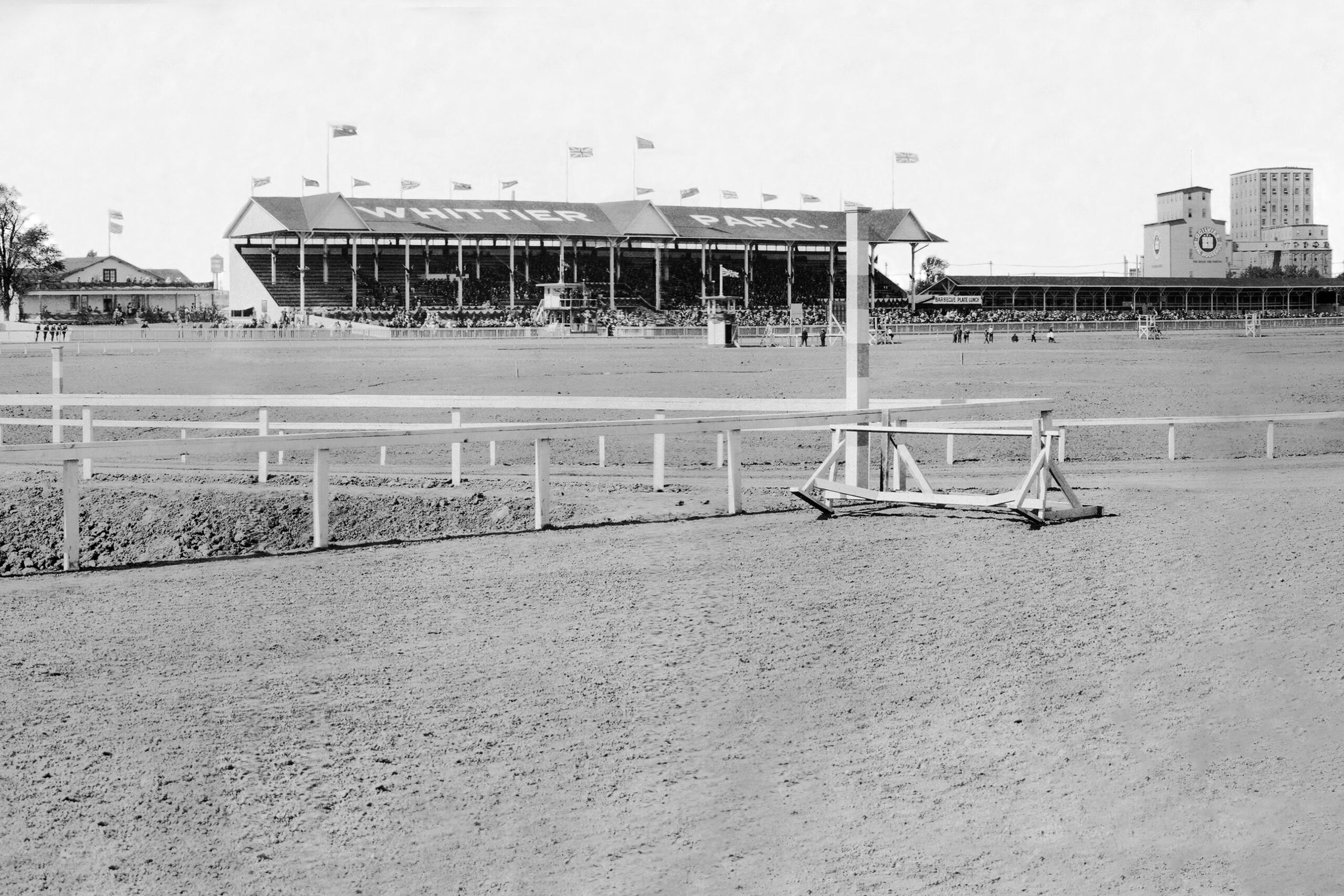
Whittier Park circa 1929. (Simms Family)
By Track Historian Bob Gates
How about a day at the races, Whittier Park style? “Return with us now to those thrilling days of yesteryear (The Lone Ranger)” to Whittier Park, Saturday, September 14, 1935.
Let’s set the scene. Whittier Park was built on the banks of the Red River in St. Boniface in 1924. The racetrack, which included the grandstand, clubhouse and barns, occupied the entire expanse of present-day Whittier Park, home of Fort Gibraltar. The track was bordered on the north and east by the Red River, the CNR main line in the south and Rue St. Joseph in the west.
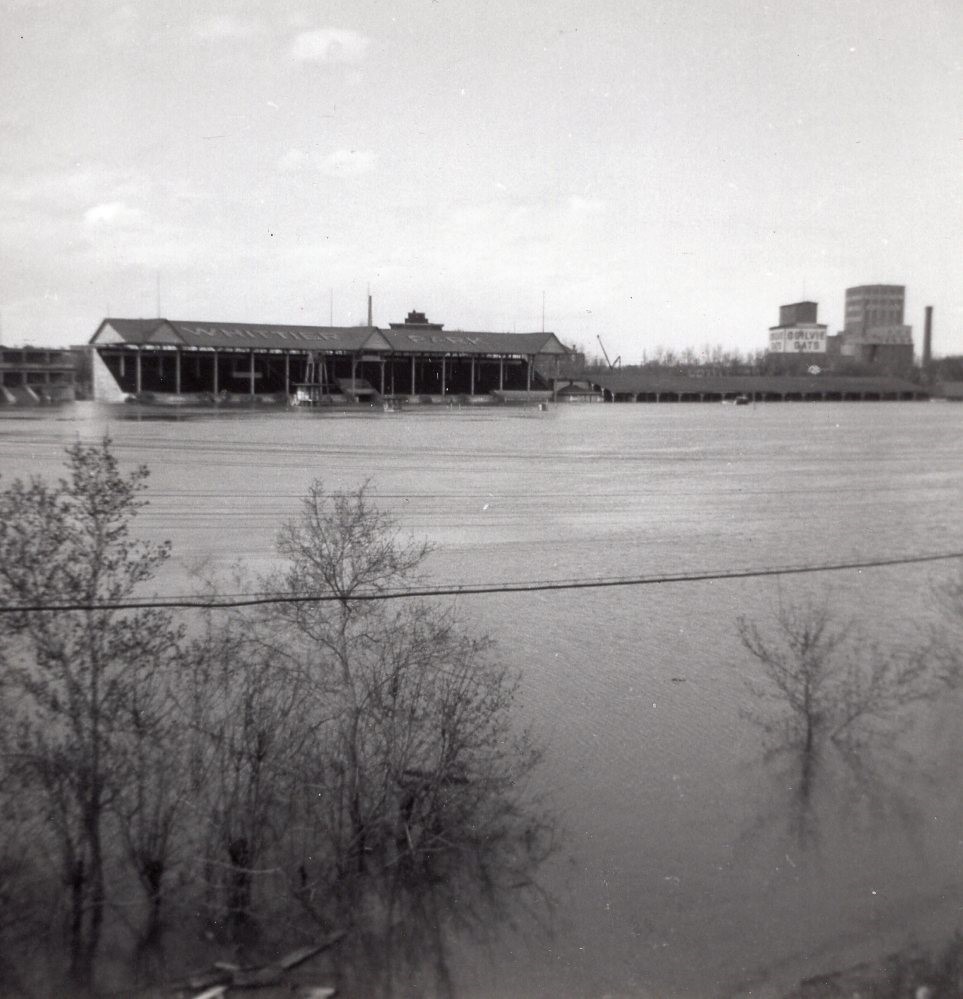
Whittier Park suffered the rage of the 1950 Red River floodwaters. (Berube Family)
Whittier operated from 1924 to 1942, only nineteen seasons, before wartime gas and rubber rationing resulted in restricted transportation access to the St. Boniface track. In those early days, the local racing season was restricted to four, seven-day meets, 28 days in total. These were split with 14 days each for Polo and Whittier Parks, with both having a 7-day spring and a 7-day fall meet.
In 1935 Whittier’s spring meet ran from June 15 to 22nd and the autumn meet from September 7 to the 14th. Saturday the 14th was the final day of the autumn meet. The inspiration for our day at the races come to us compliments of an original program that was donated to the Downs by Larry Reid. With the passage of time, we are to be forgiven if the names it contains are strange to us.
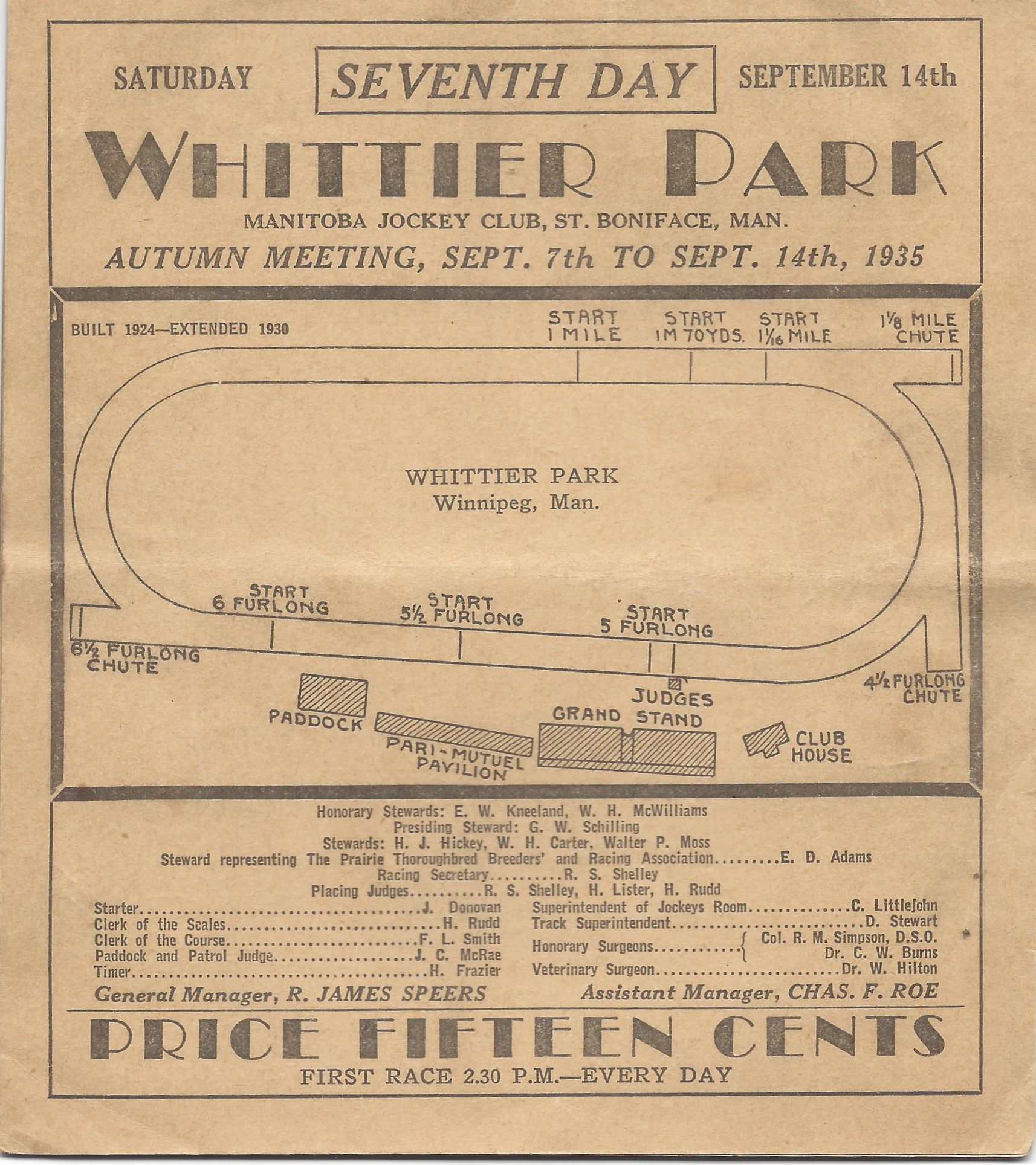
Whittier Park Program September 14, 1935. (Larry Reid)
he September 14th card had seven races and all but race five had full ten-horse fields. Race five, the “Autumn Handicap,” had eight entries. Perhaps a few of the racing officials listed on the program cover might ring some bells:
Presiding Steward: G. W. Schilling (George)
Starter: J. Donovan (Jim)
Clerk of the Scales: H. Rudd (Harry)
Clerk of the Course: F. L. Smith (Floyd)
Track Superintendent: D. Stewart (Dave)
Honorary Surgeon: Dr. C. W. Burns
The only horse from the entire card that I was able to recognize was Sunny Marcus, and that was only because of a blog story I did about his owner, Andy Robinson, in 2024.
There were only two owners whose names I could recall. One was Mrs. L. Marsh, who I believe may have been Montana’s Lonnie Marsh’s wife. The Marshes were a racing family. Perhaps some remember Gordie Marsh, who raced at the Downs for years.
The other owner was Alfred Tarn, who was the subject of another one of my blog stories from 2020.
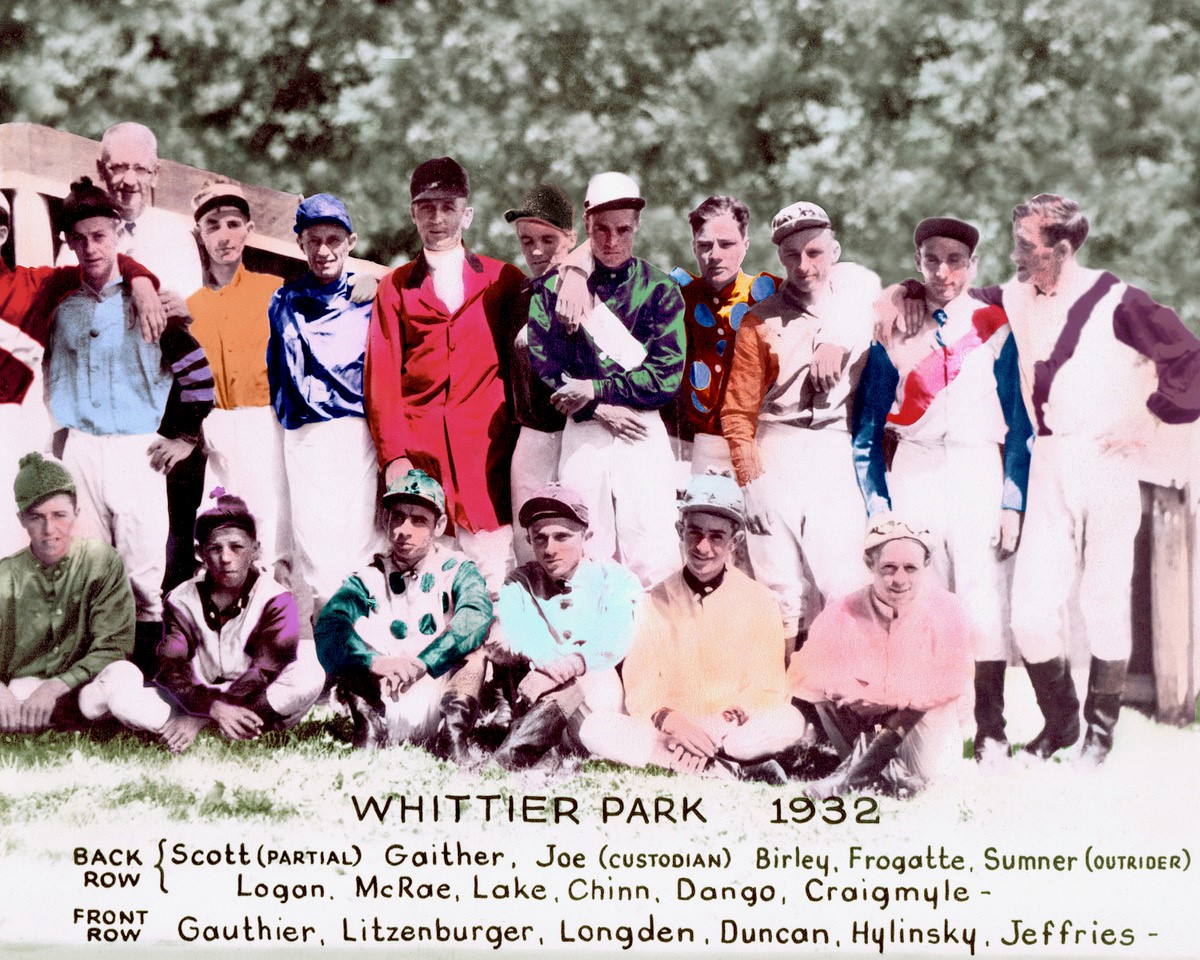
Whittier Park Jockeys 1932. (ASD Archives)
Familiar riders from the 14th include Lorne Du Pre, Harvey “The Pumper” Duncan, who rode many a horse for our own “Bert” Blake, but there are two others that we should recognize: Johnny Longden and Harry Jeffrey.
Longden’s career spanned 39 years, from 1927 to 1966. When he hung up his tack, he had 6,032 victories; no jockey had more! In 1943 he won the American Triple Crown on Count Fleet. At the 1961 Kentucky Derby, he was asked which racetrack was the toughest he ever rode. His answer… was Winnipeg’s Whittier Park! He said that the short first turn on the 5/8’s track was almost worth a rider’s life.
Attendance for the final card of racing topped 8,000. The star of the day was none other than Johnny Longden, who rode four winners from seven mounts. Longden won both halves of the daily double, which at that time was on races one and three.
Here’s a rundown of the winners of our “featured” card along with their respective “win” prices. Except in 1935 and for many years thereafter, a “win” mutuel ticket was known as a “straight” ticket:
First Race: Chile Gold (J. Longden) – $13.10
Second Race: Princess Han (A. Siewart) – $8.40
Third Race: Buddover (J. Longden) – $6.65
Fourth Race: Scotias Flag (L. Du Pre) – $5.25
Fifth Race: Broadway Roxy (J. Longden) $6.45
Sixth Race: French Maid (H. Palaez) $5.00
Seventh Race: Excellency (J. Longden) $3.20
It was a day for the favourites, but a tough day on the track. The September 14 track was drying from earlier rains and was “cuppy,” with footing described as treacherous. The second, third and seventh races each had a horse fall, but all equines and riders escaped with only minor injuries.
In addition, during race three, jockey Bodiou was unceremoniously dumped by Chief’s Surprise, but he too had only bumps and bruises. In the fourth race, A. Siewert was unseated three times by Don Marcus before they even got to post. While Siewert was only shaken up, he was taken off his mounts for the balance of the card.
And this is where our Harry Jeffrey comes in. Harry was just getting his start in racing and had no mounts that day, but he got the ride on Siewert’s Kansas Hope in the seventh race. However, this didn’t work out very well for Harry, as Kansas Hope was one of the three horses that fell that day. Fate was on Harry’s side, as he too was spared any significant injury.
After his riding career, Harry became one of the first employees of Assiniboia Downs in 1958 and was track superintendent from 1958 to 1973, when he accepted the director of racing post. Sadly, Harry was taken from us too soon; he passed on October 3, 1973. He was only 55.
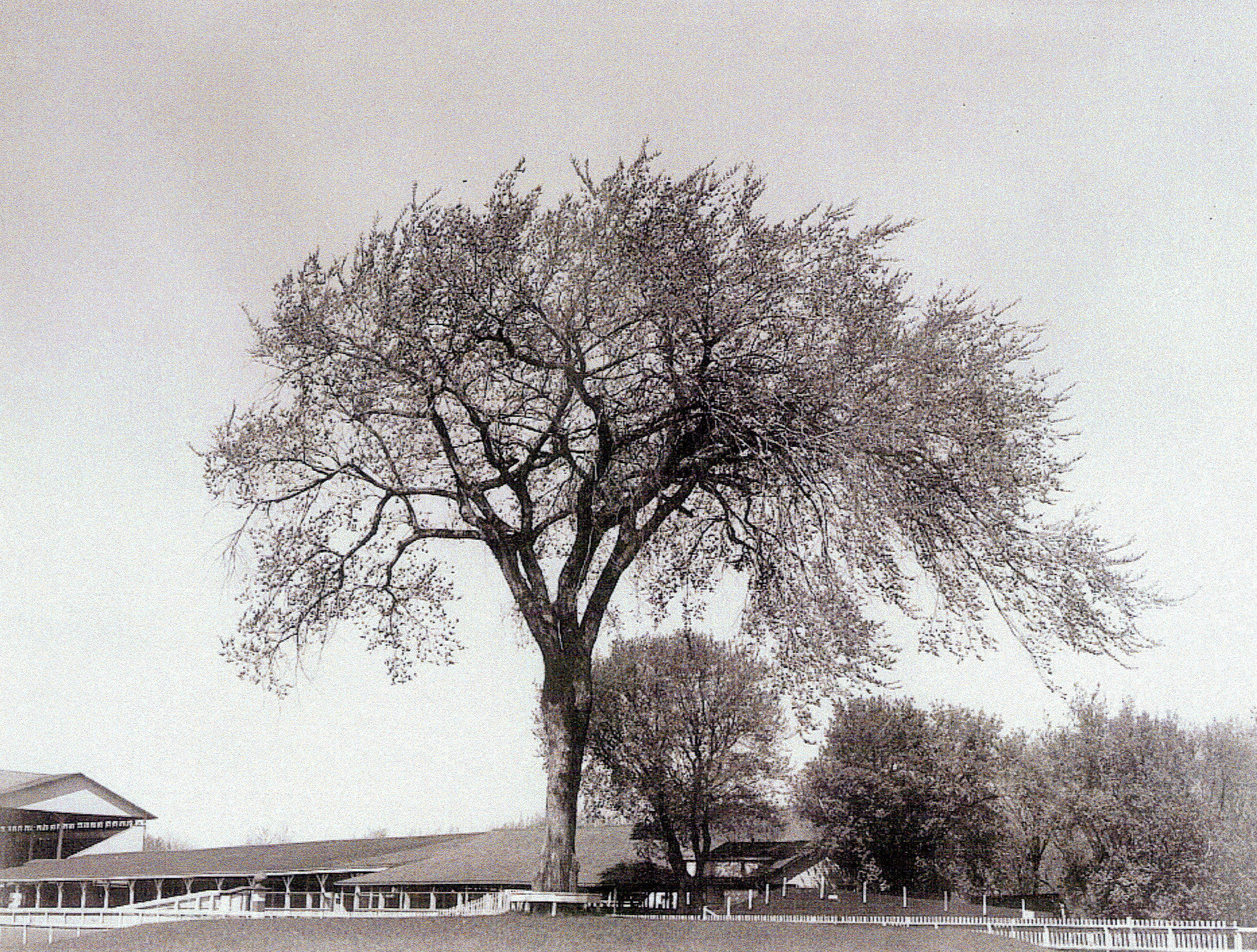
Whittier Park and its famous tree located in the infield of the racetrack circa 1935. (Winnipeg Free Press)
And there you have it, a day at the races Whittier Park style, with its “palatial” setting of manicured lawns, white buildings, all roofed in bright green with “Whittier Park” emblazoned on the grandstand roof in huge white letters.
I hope you enjoyed our 91-year retrospective of September 14, 1935. Once again, our thanks go out to Larry Reid for his generous donation of an official program from old Whittier Park.
You might wonder why would we bother to talk about a day where most of us do not remember the names from more than 90 years ago? Well, that’s because that is what we do here at the history blog…
We keep their hoofprints and footprints alive by telling their stories.